Technological Surveillance and Bodily Autonomy
Made for LoveTechnological Surveillance and Bodily Autonomy is the novel’s sustained conflict between technologically enabled observation and Hazel’s right to privacy and self-direction. In her marriage to Byron, surveillance moves from the home’s access systems to bodily scans and the monitoring of thought. Technology presented as safety, convenience, or progress thus becomes a means of interpreting and constraining her life. Hazel’s resistance begins not with a competing device but with the decision to refuse devices and recover ordinary, imperfect ways of moving through the world.
Domestic Systems and the Promise of Safety
The Hub, Byron’s name for the couple’s domestic compound, makes technological control part of its architecture. Entry depends on voice and retinal detection; some rooms add fingerprint checks and keypad codes, while cars are operated remotely. Against these systems, the physical key to Hazel’s father’s house offers a different kind of access. Hazel wants the small, manual object not merely as a practical alternative but as a step away from the technological environment that has organized life with Byron.
The Sleep Helmet extends this design logic into the bedroom. Byron’s helmet responds to Hazel’s stress by displaying a question about whether to wake him, leaving the decision to her; she has never chosen to do so. Its function is presented as protective and considerate, but it also reveals how intimate decisions have been incorporated into an automated system. The helmet monitors sleep and can alert emergency personnel if the wearer’s vital signs become dangerously abnormal and fail to respond. Byron’s Omega Sleep Helmet also monitors detected life within a set radius, so Hazel’s decision not to wear her own helmet does not remove her from the system: her safety remains covered through his device.
For Hazel, however, the helmet’s promise of protection is inseparable from unease. Its dark glass and patterned light make it appear less like neutral equipment than an enclosing presence. She regards the sensory enclosure as too close to rehearsing her own absence, while the device’s rapid sleep-inducing effect and physiological safeguards demonstrate how comprehensively it is meant to manage the body. Its design makes the central tension plain: an instrument can protect a person while also placing bodily processes under continuous technical observation.
From Observation to Marital Control
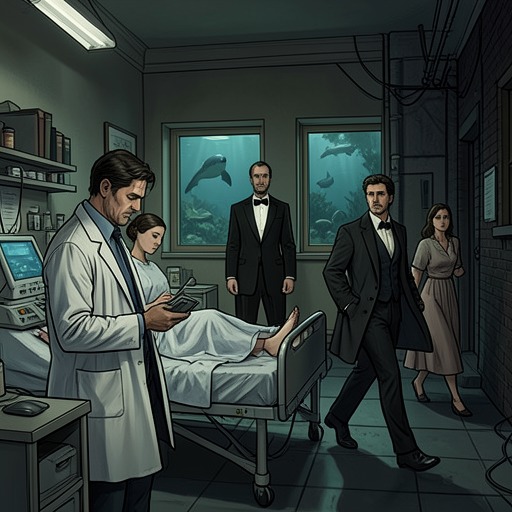
Hazel’s experience changes as she realizes that the sensors in The Hub are not incidental features. At first, she tries to accept Byron’s assurances that monitoring is harmless. Over time, he comments on her activities while away, and meals brought to her by staff change in response to bodily scans she did not know were being taken. The surveillance therefore does more than record: its data shapes the care and routine arranged around her.
The monitoring also reaches every room, including the bathroom, and Byron admits that cameras and scanners have recorded her time in the compound. He argues that the collected information can be processed to infer her state of mind with almost 97 percent accuracy, despite his lack of formal psychology training. The claim turns intimacy into a data problem: Byron treats a technical estimate of Hazel’s inner life as a substitute for knowing her through conversation and mutual trust. For Hazel, the result is not greater closeness but the loss of a private space in which her actions and thoughts need not be available to him.
The strain enters their marriage in concrete ways. Hazel recalls that they once had what she considered an ordinary amount of sex, but that physical intimacy later became one of the few boundaries she could still impose. Her withdrawal is connected to the discovery that even apparently private moments have been observed. The conflict is not simply whether a particular device is useful; it is whether a person can maintain bodily and emotional boundaries when one partner controls the systems that record and interpret her.
Refusal and the Recovery of Ordinary Space
After leaving Byron, Hazel treats technological refusal as a way of re-establishing distance from him. She wants to live manually and simply, and to stop relying on the tools associated with the future-oriented culture she had inhabited. She describes the project to herself as deprogramming, while recognizing that her departure means she was not wholly shaped or controlled by Byron. The distinction matters: resisting surveillance is not only escape from a system but also an attempt to recover confidence in her own judgment.
Her father’s neighborhood becomes a test of that resolve. Hazel could use a Gogol search application to locate a nearby bar in seconds, but she decides that this is precisely the kind of dependence she wants to abandon. Instead, she intends to form her own mental maps, accepting that they may be fallible and distracted. The contrast sets technological efficiency against the slower work of learning a place through personal experience. Imperfection becomes part of autonomy rather than proof that an automated guide is necessary.
The corporate culture behind these tools gives Hazel’s personal refusal a broader context. At Gogol, reliance on technology is treated as a sign of strength, and the degree of reliance helps determine a person’s perceived value. Byron’s response to a hypothetical employee who had transferred her brain into a robotic body is revealing: he says he would do the same himself and would reward the employee with leadership of the company if the result could not be replicated. His enthusiasm for an immortal technological executive places bodily replacement and indefinite life within the company’s idea of competitive advantage. Hazel’s wish to step away from that future is therefore also a rejection of the values that make technological dependence a measure of worth.
The Mind as a Site of Surveillance
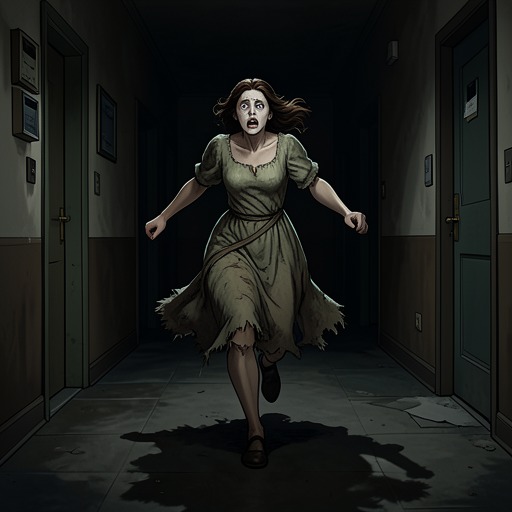
The most radical breach occurs when Byron reveals that Hazel’s experience outside The Hub has also been captured. When she challenges how he could know what she had seen in a place without cameras, he explains that her own perception is serving as the recording mechanism. The disclosure changes the scale of the problem: leaving the compound and avoiding visible cameras cannot guarantee privacy if information can be taken from her mind.
Byron explains that Hazel’s prototype has no active GPS because such a signal would be detectable. Instead, each download supplies her exact coordinates. This gives Hazel a 24-hour lead, but not a lasting escape: Byron says she would lack the resources to outrun the system every day. Surveillance here joins mental access to physical pursuit. The information does not merely let Byron know where Hazel is; it helps make continued evasion difficult.
The same logic reaches objects offered as practical help. Byron has put basic electronics in a weatherproof safe for Hazel and asks her to retrieve a mobile device and call him through a secure line. She refuses the offer and says she does not want to use electronics. Later, when she tries to sell the gifts, a shop employee identifies them as embargoed Gogol products. Such items may contain unreleased features or sensitive information, and Gogol pays more to recover them so they do not circulate. Hazel realizes that the gifts may have been customized with surveillance enhancements. Assistance and entrapment become difficult to distinguish when the objects come from the person monitoring her.
Anonymity, Visibility, and Significance
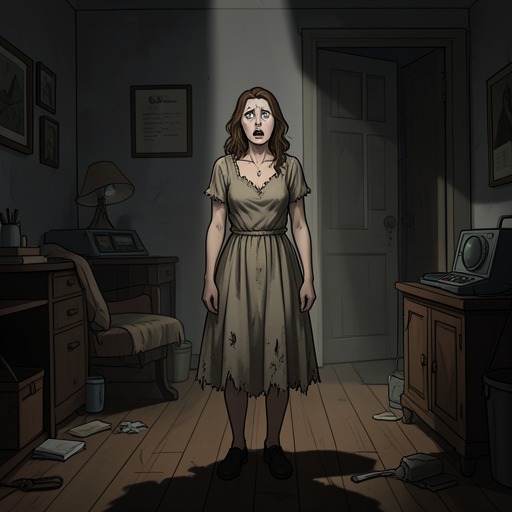
Hazel’s attempt to live outside Byron’s influence remains uneasy. Even after leaving The Hub, she fears that he may still be recording her, and moments that seem private are shadowed by the possibility of observation. Yet she also reminds herself that she existed before knowing him and can exist without him. This recognition does not instantly restore security; it supplies a basis for imagining a life that is not defined by the monitored domestic world she left.
Her use of a public library computer shows how surveillance affects even cautious efforts to gather information. Hazel avoids checking her own accounts or searching for Byron, Fiffany, or herself, because any search might give an algorithm a clue to her location. Instead, she scans news headlines and learns indirectly that Byron and Fiffany are now together. The episode connects personal privacy to public visibility: avoiding direct contact with technology does not erase the fear that one’s identity can be located through traces left in information systems.
Across these episodes, autonomy is measured through small choices as much as dramatic escape: using a physical key, declining a helmet, refusing a phone, and navigating without a search application. The novel sets these choices against a system that converts bodily signals, sleep, perception, and location into accessible information. Its critique does not depend on denying that the devices can offer safety or convenience. Rather, it shows the imbalance created when the person who gathers and interprets the data also holds power over the person being observed. For Hazel, reclaiming herself begins with insisting that not every thought, movement, or bodily condition has to become someone else’s knowledge.